SEC Proposes Overhaul of Executive Compensation Disclosure Rules
On Nov. 13, 2026 — just over 20 years since the Securities and Exchange Commission’s last rewriting of the Securities Exchange Act rules governing the disclosure of executive and director compensation — the SEC proposed major changes to its disclosure regime, including those portions adopted less than five years ago by the SEC under the direction of the Dodd-Frank Act.[1]
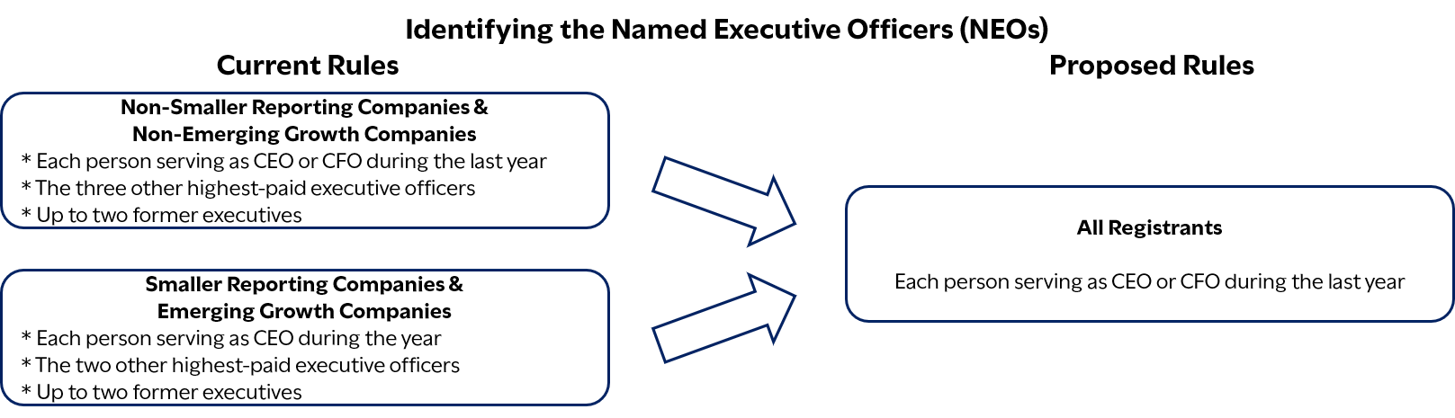
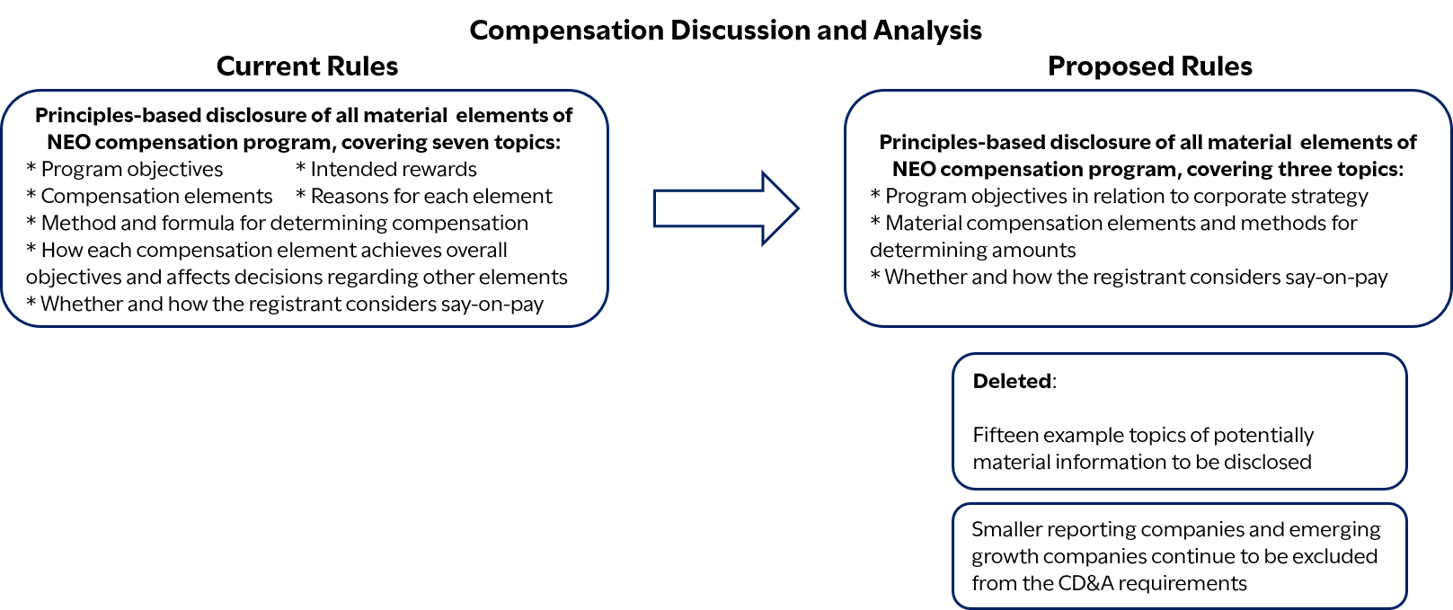
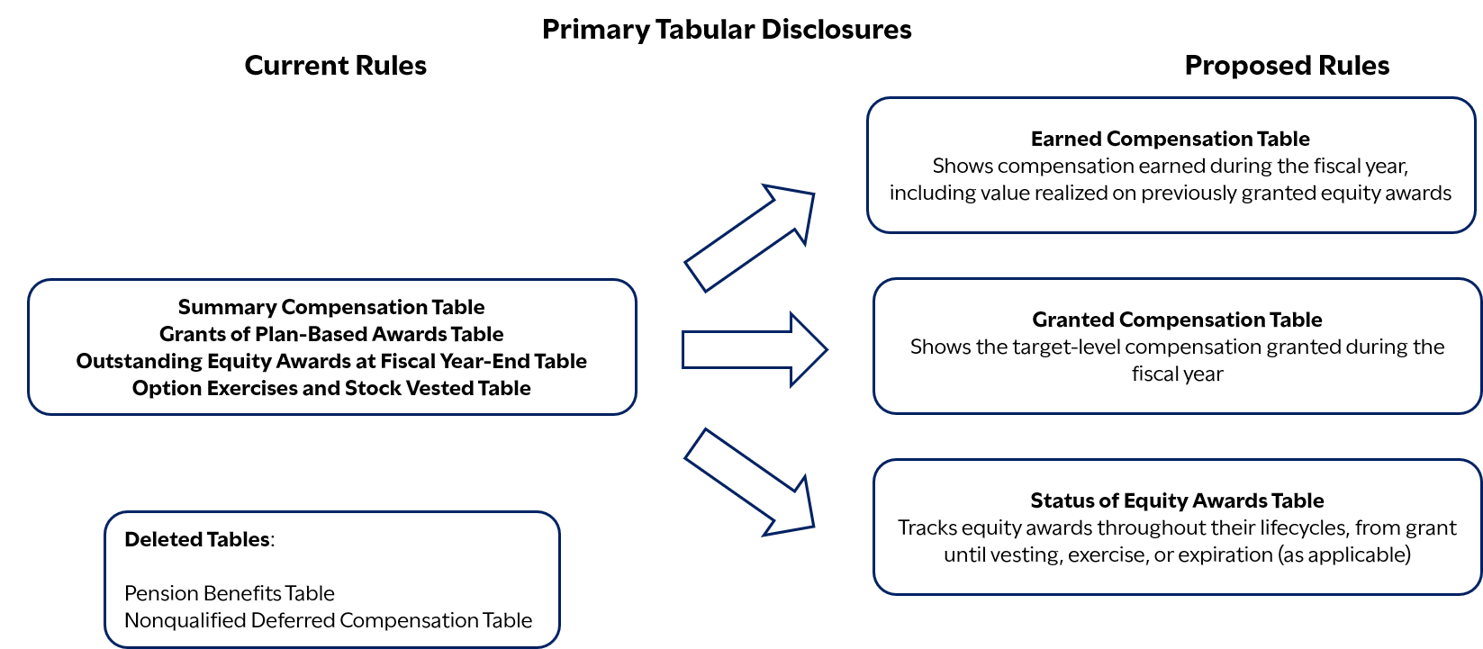
The proposal aims to simplify disclosures in a number of ways: reducing the “named executive officer” (NEO) group to two executives, reorganizing and simplifying multiple tables and deleting others, shortening the Compensation Discussion and Analysis (CD&A) narrative disclosure, and eliminating much of the currently required footnote disclosure in the tables. By reducing much of the complexity in the current disclosure regime, the SEC is aiming to achieve its stated goals of reducing the compliance burden on public companies while improving the clarity and usefulness of disclosures to investors. Consistent with the current disclosure regime, the SEC remains focused on “principles-based” disclosure of material information. Taken together with the SEC’s proposed rule enhancing emerging growth company accommodations and simplifying filer status for reporting companies, if the proposals are all passed, there will be less mandated compensation-related disclosure across all filer types; however, the incremental benefit of certain changes, like the simplified CD&A, will inure only to the benefit of a diminished large accelerated filer population, since non-accelerated filers will already be exempt.
The proposal is subject to a 60-day comment period following Federal Register publication. As proposed, the rules would take effect on Jan. 1 of the year following their adoption. Companies may choose to follow the new rules earlier if they comply with every changed item in full after the rules’ effective date. Assuming the final rules are adopted in 2027, these changes would become mandatory in the 2029 proxy season for calendar-year registrants.
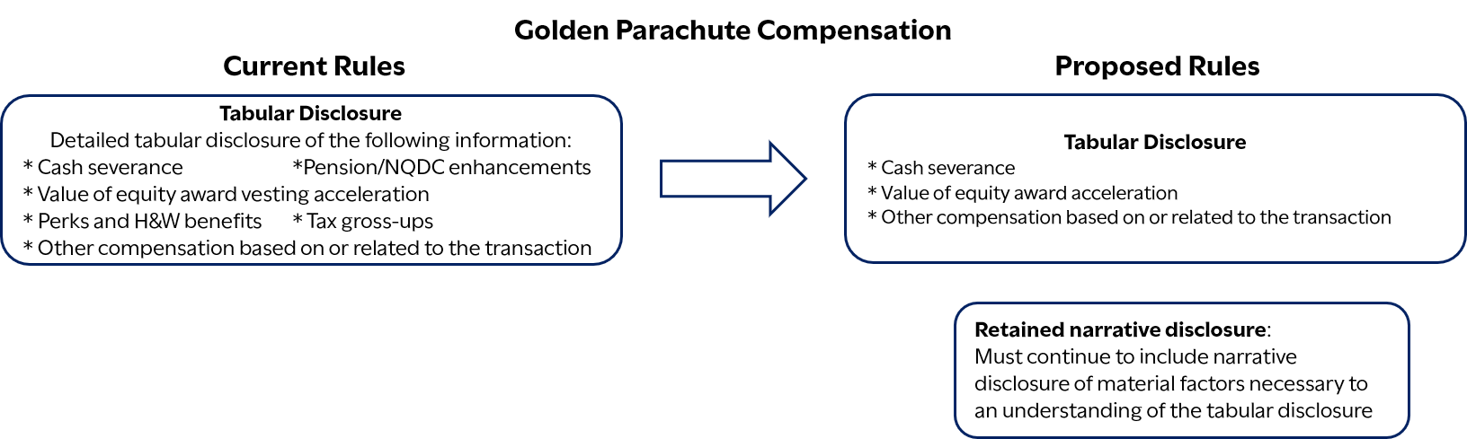
A high-level summary of the proposed changes to the current disclosure regime is available here[2] and below. In addition, the following is a summary of some important impacts of the proposed changes, a comparison of the proposed rules to international disclosure regimes, and some key considerations for issuers as they prepare for the upcoming proxy season.
Selected Impacts of the Proposed Rules
Since many other securities laws refer back to the NEO definition in Regulation S-K, the narrowing of this definition to include only the CEO and CFO will affect more than the compensation disclosure section of annual proxy statements. Additionally, the tax rules under Section 162(m) of the Internal Revenue Code rely on these rules to apply limitations on compensation expense deductions allowable to public companies. Below is a list of some possible ripple effects of these proposed rules if they are adopted:
- Form 8-K: Item 5.02(b) of Form 8-K requires disclosure of the retirement, resignation, or termination of specified executive officers including NEOs. Item 5.02(e) of Form 8-K requires disclosure when an NEO’s pay arrangements are implemented or materially modified. With fewer NEOs, these filings would become less frequent, and investors would have less real-time information regarding departures and compensation actions affecting non-CEO, non-CFO executives. The SEC estimates that companies would file about 700 fewer Form 8-Ks per year. Item 5.02(b) departure reporting would continue to cover the principal executive officer, president, principal financial officer, principal accounting officer, and principal operating officer regardless of NEO status, and Item 5.02(c) would still require some pay disclosure when an officer is newly appointed to certain key roles. The SEC also proposes to eliminate Item 5.02(f), which requires subsequent reporting of compensation that was incalculable at the time of an annual filing.
- Material Contract Disclosures: Item 601(b)(10)(iii)(A) of Regulation S-K requires certain SEC filings to include as an exhibit a copy of each material management contract and compensatory plan. Compensatory contracts and plans in which any NEO participates are deemed material, whereas contracts and plans in which other executive officers participate may be omitted from the exhibit list if they are immaterial in amount or significance. With fewer NEOs, public companies may conclude that certain compensatory contracts and plans need not be filed as exhibits to their SEC filings even if an executive officer participates.
- Say-on-Pay and Golden Parachutes: Shareholders’ advisory say-on-pay votes and the disclosure and vote on golden parachute payments in mergers would cover only the CEO and CFO. The same reduced scope would apply to golden parachute disclosure in going-private transactions and third-party tender offers under Item 1011(b) of Regulation M-A. The proposed rule would consolidate several columns in the current Golden Parachute Compensation Table and simplify the narrative disclosure requirements.
- Other Disclosures: Companies would have to report individual beneficial stock ownership only for the CEO and CFO (reporting for all directors and executive officers as a group would continue, and Section 16 filings would remain a source of individual ownership information). Fewer executives could use the exception from the “related person” transaction disclosure rules that applies to pay already reported in the registrant’s regular proxy disclosure.
- Perquisites at Smaller Companies: A $150,000 threshold is immaterial at a company whose CEO is paid $20 million in total annual compensation. But about 5% of U.S. domestic public companies pay their CEO $500,000 or less, and for them, perquisites representing 30% or more of pay could go undisclosed, which could encourage enhanced use of generous perquisites.[3]
- Section 162(m): A smaller NEO group does not mean that companies can stop tracking pay for other executives. Section 162(m) of the Internal Revenue Code limits a public company’s tax deduction to $1 million per year for the compensation paid to each “covered employee,” a group that includes the three highest-paid executive officers other than the CEO and CFO. In the proposal, the SEC notes that Treasury staff advised that Section 162(m) still applies to these executives even if their pay no longer has to be reported, so companies may, for tax purposes, still have to rank their executives by total compensation based on the SEC’s disclosure rules.[4] The proposal does not indicate, however, whether the highest-paid executives should be determined by reference to the new Earned Compensation Table or the new Granted Compensation Table. Note that the definition of “covered employee” for purposes of Section 162(m) is due to expand in 2027 to cover the five highest-paid individuals among all employees of a corporation.
- Benchmarking: With less publicly available information regarding non-CEO, non-CFO executive compensation, industry groups and peer companies, compensation consultants, and compensation committees will have less real-time data readily available for generating compensation surveys and peer group comparisons and for analyzing the competitiveness of proposed pay packages and arrangements.
- M&A Diligence: With less public information available regarding executive pay structures and amounts, claw-backs, change-in-control arrangements, and stock holdings, we expect that buyers, investors, and other parties will need to rely more on direct information requests and on the representations and disclosure schedules when pursuing corporate transactions.
The recent 2026 midterm election has raised questions about the permanence of scaled-back regulatory compliance regimes, and future White House administrations could seek to reinstate an expanded disclosure regime.
Comparison to International Disclosure Regimes
The SEC has been transparent about its mission to make the U.S. public markets more accessible, including by simplifying the disclosure process and the pathway to an initial public offering. This proposal is one of several recent initiatives toward that end, following the SEC’s May 2026 proposals to extend scaled disclosure accommodations to more companies and to expand eligibility to use Form S-3. Notably, these reforms would bring the U.S. reporting regime into closer alignment with the public disclosure regimes of other jurisdictions. A table comparing the proposed U.S. regime to the executive compensation disclosure regimes in other major markets is set forth in Appendix A.
Key Considerations
Public companies may wish to consider the following while the proposal remains subject to public comment:
- Internal Tracking: Continue collecting compensation data for executives other than the CEO and CFO for board oversight and accountability purposes, Section 162(m) tracking where applicable, compliance with remaining SEC disclosure and say-on-pay requirements, benchmarking against industry peers, retention and incentive alignment, responses to investor and proxy advisory firm inquiries, and management of public relations considerations.
- Perk Policies: Review how perks are evaluated and approved in light of the proposed $150,000 threshold and begin considering in good faith whether any of the company’s currently disclosed benefits are potentially excludable under the more flexible proposed definition of perks. Companies may also wish to consider whether to use the optional de minimis tracking exclusion for fringe benefits under Section 132(a)(4) of the Internal Revenue Code, and how to value perks if the requirement to use aggregate incremental cost is eliminated as proposed.
- Disclosure Planning: Consider whether moving to the new tables, including the ability to adopt them early, would improve the company’s proxy preparation procedures. Under the proposal, early compliance would be permitted after the effective date only if the company provides disclosure responsive to the amended item in its entirety, and mandatory compliance would begin with the first full fiscal year ending on or after the effective date. Large accelerated filers should also plan for the proposed Inline XBRL tagging of the three new tables, although it is highly likely that the definition of “large accelerated filer” will change before the rule is finalized, so companies that anticipate falling within the proposed definition should monitor whether this requirement will apply to them. Companies may also wish to begin considering how their CD&A will describe the objectives of their compensation program in relation to corporate strategy.
- Comment Letters: The SEC has requested comments on numerous aspects of the proposal, including whether it should provide further guidance on perks such as executive security, whether the new tables would accommodate phased-in transition relief, and whether any of the proposed changes would result in the loss of material information to investors.



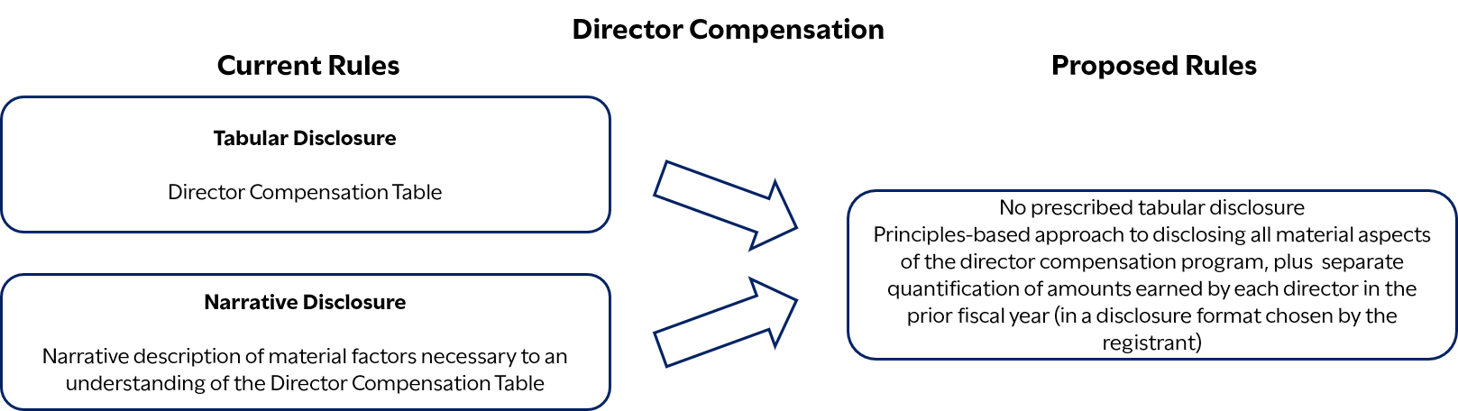
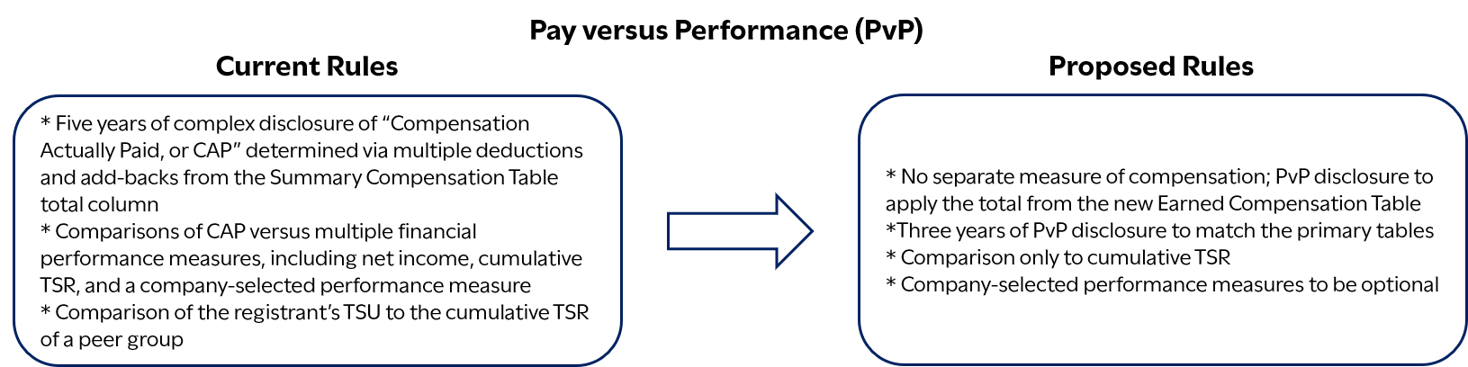


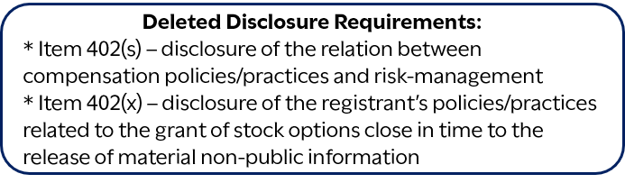
Appendix A – Comparison of the proposed U.S. regime to executive compensation disclosure regimes in other major markets.
| Jurisdiction / Exchange | Directors | CEO | CFO and Other Senior Executives | Highest-Paid Executives |
|---|---|---|---|---|
| United States (current rules) | Required | Required | CFO required; other senior executive officers only if among the three most highly compensated | Three most highly compensated executive officers other than the CEO and CFO (if compensation > $100,000), plus up to two former executive officers who would otherwise qualify |
| United States (as proposed) | Required | Required | CFO required | No separate category |
| London Stock Exchange (main market)[5] | Required, including non-executive directors | Required | Only if a director | No separate category |
| Hong Kong Stock Exchange[6] | Required | Required | Only if a director; but voluntary disclosure encouraged and relatively common | No separate category |
| Tokyo Stock Exchange[7] | Required if compensation ≥ ¥100 million | Required if compensation ≥ ¥100 million | Required if considered a statutory executive officer with compensation ≥ ¥100 million | Statutory executives paid above ¥100 million |
| Shanghai / Shenzhen Stock Exchanges[8] | Required | Required | Required | No separate category |
1.
Executive Compensation Disclosure Reform, Securities Act Release No. 33-11455; 34-106873; IC-36385, File No. S7-2026-39 (proposed Nov. 13, 2026), available at: https://www.sec.gov/rules-regulations/2026/11/s7-2026-39 (the “Proposed Rule”).
2.
See also Proposed Rule at 25, for the SEC’s chart summary of the proposed rule changes.
3.
Based on the SEC’s analysis of compensation data from Standard & Poor’s Execucomp database.
4.
Proposed Rule at 38 n.92.
5.
Companies Act 2006 sections 420 and 421, plus the Large and Medium-sized Companies and Groups Regulations 2008, regulation 11 and Schedule 8.
6.
HKEX Main Board Listing Rules Appendix D2, paragraphs 24, 24.5, 25, and 25.1; Appendix C1 recommended best practice E.1.8.
7.
Japanese FSA Disclosure Ordinance / annual securities report framework, as summarized by FSA, and TSE/JPX corporate-governance report guidance.
8.
CSRC Standards No. 2 for Annual Reports, Article 30, as hosted by SSE, plus SSE Listing Rules requiring periodic reports to be prepared under CSRC and exchange requirements.