
Client Alerts
FDI Screening in France in 2025: Continuity, Limited Changes and an Overcautious Regime?
October 12, 2026
By Camille Paulhacand Melissa Hui
On 24 September 2026, the French Ministry of the Economy (Minefi) and the French Treasury released their annual report on foreign investment screening in France (Report), providing insights into FDI trends and developments in 2025. France remains the leading EU destination for foreign investment for the seventh consecutive year, and the Report highlights continued scrutiny of investments in sensitive sectors. Beyond statistics, this year’s Report goes further than previous editions by providing examples of how the regime is applied in practice, making it a useful source of guidance for investors (i.e., soft law).
Key Takeaways
- Increased scrutiny, longer reviews. The number of filings increased by approximately 16% between 2023 and 2025, reflecting a steady expansion of French FDI screening regime, which has contributed to longer review periods for investors.
- Conditions can be anticipated. With almost one in two authorisations subject to conditions, investors should assess early on the potential scope, cost and operational impact of FDI conditions.
- Preliminary assessment requests provide added value. There is a high rate of out-of-scope decisions (48% of filings), while 72% of prior rulings concluded that the activity was not subject to screening. This could suggest that that too many filings are being made on a cautious basis. Preliminary assessment requests provide certainty upfront. While guidance in the Report is welcome, the French FDI authorities could go further and provide additional guidance to reduce the number of cautious filings.
- Recent legislation extends scrutiny of minority stake acquisitions in listed companies. The 10% voting rights threshold now applies to French-listed companies that are also listed on certain regulated markets outside the EU and EEA (including the London Stock Exchange and Nasdaq) — which would benefit from a fast-track notification procedure.
- Harmonisation is expected in 2028. The revised EU FDI regulation will harmonise the scope of investment screening and timelines in the EU and strengthen cooperation across Member States.
More Filings, Closer Scrutiny
2025 saw a record number of filings: 418 submitted, compared to 392 in 2024 and 309 in 2023, i.e., more than three times the volume recorded in 2014.
- Of these, 48% were found to be out of scope of the FDI screening regime, reflecting a trend towards focusing efforts on transactions with critical implications for national interests. This was particularly the case in sectors such as agri-food (90%), renewables energy (83%) and software solutions (55%) — see the chart below.
- Of the 323 decisions issued, a total of 167 investments were authorized, nearly half of which (49% or 82 decisions) were subject to conditions, representing a slight decrease compared to 2024 (54%). This figure stands out when compared to other FDI regimes, where conditional approvals typically represent a much smaller proportion of all decisions.
- Only seven investments have been blocked over the past four years (this number does not include transactions abandoned).
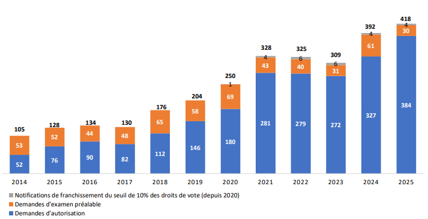
Number of FDI filings reviewed in France between 2014 and 2025
In addition, 25 decisions were issued following requests for preliminary assessment as to whether an activity falls within the scope of the FDI screening regime. Designed to provide companies with greater certainty at an early stage of the investment process, the preliminary assessment process has practical value with 72% of assessments concluding that the activities concerned fell outside the scope of the FDI screening regime.
With regards to the sectors concerned, essential infrastructure, goods and services (e.g., water, energy, transports, etc.) remain the largest category, accounting for 38% of authorised investments. This is followed by sensitive activities by nature (e.g., defense and security), accounting for 22%, and R&D activities relating to critical technologies (e.g., AI, cybersecurity, semiconductors, etc.), accounting for 11%. This also stands out by international comparisons, with a large number of other FDI screening regimes focusing the majority of their cases on the defense and security sector. (France has a particular focus on sectors deemed essential.)
Foreign investors are predominantly based outside the EU/EEA. Financial investors account for half of investors, with industrial investors representing a third.
For the first time, the Report provides figures on monitoring activities: The Minefi questioned 120 companies last year to make sure that investors are complying with conditions imposed. There has been additional attention to compliance, which was reinforced by a declaration from the minister of economy in September 2026 that it would impose fines in case of noncompliance.
Can Guidance Provided in Annual Reports Be Considered as Soft Law?
This year, the Report again provides examples in writing that reflect the current practice of the French FDI authorities, building on the guidance provided in the existing guidelines. This continues, however, to be a limited exercise and could be expanded to further reduce the number of cautious filings.
- Additional illustrative examples. Adding to the existing guidelines, the Report provides concrete examples of situations underlying certain decisions. It highlights the conditions that could be imposed on investors and provides specific insights into governance-related conditions (such as restrictions on access to sensitive information, separation of IT systems, specific requirements regarding key personnel or establishment of security committee with state representatives).2
- Guidance on activities falling outside the scope of the regime. The Report provides guidance on activities unlikely to fall within the FDI screening regime, notably in the renewable energy, software and agri-food sectors. This provides greater visibility — although the Report still says that the assessment remains fact-specific.
- Revision of conditions. The Report (for the first time) sets out that Minefi has agreed to revise or repeal conditions in six out of seven requests in 2025.
Recent and Upcoming Regulatory Changes
At the national level, Decree n°2026-718 and a ministerial order dated 30 July 2026 clarify that the 10% voting rights threshold is applicable to French companies listed on certain third-country stock exchanges as defined in the ministerial order (including the London Stock Exchange and Nasdaq).
At the EU level, the revised Foreign Investment Screening Regulation, adopted on 17 June 2026 and applicable from January 2028, will broaden and harmonize investment screening across the EU, in particular regarding review procedures and timelines. While the French regime is already largely aligned with the new framework, France will need to expand the scope to cover additional activities: (i) the development, production and marketing of dual-use items covered by Annex I to Regulation (EU) 2021/821, (ii) electoral infrastructure and (iii) a broader range of financial services and infrastructure. The revised regulation will also extend screening to EU companies controlled by third-country investors and strengthen cooperation between Member States and the European Commission. Importantly, however, the new framework does not create a “one-stop-shop”: Member States remain exclusively responsible for screening transactions with a local nexus to their territory.
What to Expect Looking Forward
The figures are not particularly surprising: The number of filings continue to increase, almost half of authorisations are subject to conditions and the French FDI authorities are conducting an increasing number of compliance investigations. This is likely to continue to be the case.
However, the additional practical guidance provided by this year’s Report is welcome and should be encouraged and increased (in any form), as it provides better visibility to investors. This is all the more important considering the pace of investigations can be slow.
Contributors


Practice Areas
For More Information